Transform Your Routine: Editable Chore Chart Canva Template 2
Let's be honest, the phrase "chore chart" doesn't exactly spark joy for most adults. We picture faded magnets on a refrigerator or a crumpled piece of paper taped to a wall, barely glanced at after the first week. But what if managing household or classroom tasks felt less like a nagging obligation and more like a streamlined, visually pleasing system? That's the core promise of the Chore Chart Canva Template 2. It’s not just a list; it’s a designed experience that leverages modern typography and layout principles to make organization actually stick.
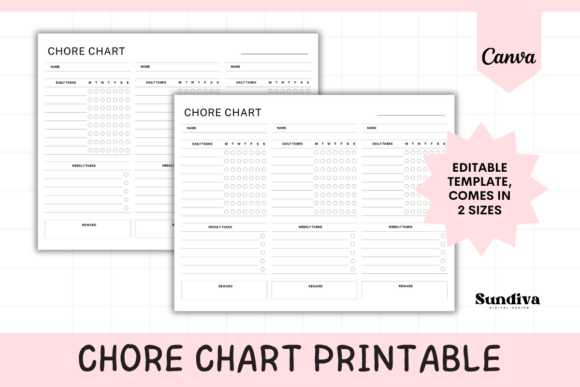
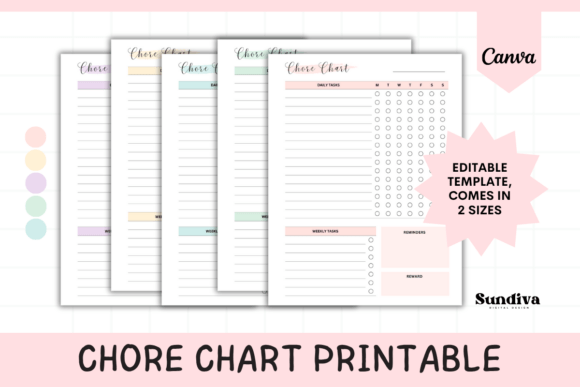
This particular template stands out because it understands visual hierarchy. As a designer, I immediately notice how it uses display font styles for headers to grab attention, paired with clean, legible sans serif font choices for the task lists themselves. This isn't a generic grid. The inclusion of a dedicated "Reward Box" and "Reminders" section shows a thoughtful approach to user psychology—it’s built to motivate, not just to dictate. The overall personality is friendly yet structured, making it suitable for a family kitchen command center or a teacher’s classroom management system. Its appeal lies in its flexibility; the layout provides the necessary structure while the editable nature in Canva allows you to infuse your own brand identity or personal style into it.
Practical Applications: Beyond the Fridge Door
While its primary use is obvious, the true value of a well-designed design asset like this is its adaptability. Think beyond simple household chores. For small business owners and entrepreneurs, this template can be repurposed as a weekly operational checklist for a small team. The "Daily Tasks" section becomes a list of key performance indicators, and the "Reward Box" transforms into a spot for acknowledging weekly wins. The clean layout ensures that even in a busy environment, the priorities are immediately clear, enhancing readability and reducing cognitive load.
For those in publishing or content creation, consider using it as an editorial calendar lite. Map out your content themes for the week—Monday for writing, Tuesday for design, Wednesday for promotion. The visual checkmarks provide a satisfying sense of progression that a digital list often lacks. Furthermore, in classroom settings, teachers can use it to outline daily student responsibilities, fostering independence. The template’s strength is its visual hierarchy; it guides the eye naturally from the day of the week to the specific task, ensuring nothing gets overlooked. This kind of structured design is crucial for maintaining consistency in any routine.
Design Details and Customization Strategy
When you open this template in Canva, you’re not just getting a static image. You’re accessing a layered file where every element is customizable. This is where your inner creative professional can play. The default color palette is likely neutral and broad-appealing, but for a family, changing the header colors to match a playroom's decor can increase engagement. For a business, aligning the colors with your company’s brand identity turns a simple chart into a cohesive piece of internal marketing material.
Pay close attention to the font pairing used in the original design. It likely combines a bold, perhaps slightly playful serif font or handwritten font for titles with a highly legible body text. If you decide to change the fonts, maintain this principle. A common mistake is choosing two fonts that are too similar, which flattens the design. Instead, aim for contrast: pair a modern typography style for the days of the week with a simple, clean typeface for the task lines. This contrast creates a natural rhythm and makes the chart scannable in seconds—a key factor for busy households or fast-paced work environments.
Maximizing Engagement and Usability
The inclusion of the reward box is a subtle but powerful feature. From a design perspective, it acts as a focal point, a visual "finish line." For families, this is where you can get creative—use stickers, write in small privileges, or leave it blank for older kids who are motivated by the checkmarks alone. For a blogger or hobbyist using this for personal project management, the reward box could be where you schedule your downtime or a creative break. This thoughtful placement encourages a healthy balance between productivity and recognition.
Remember, this is a digital product delivered as a PDF with a Canva link. The requirement of a free Canva account is standard for editable templates and actually works in your favor. It means you can access and tweak your chart from your phone or computer, making updates on the fly. The two sizes—US Letter and A4—cover most standard printing needs, whether you’re pinning it to a corkboard or slipping it into a frame. The key is to treat it not as a finished product, but as a starting point. The best design assets are those that serve as a foundation for your own creativity, helping you build systems that are as unique as the projects or families they serve.